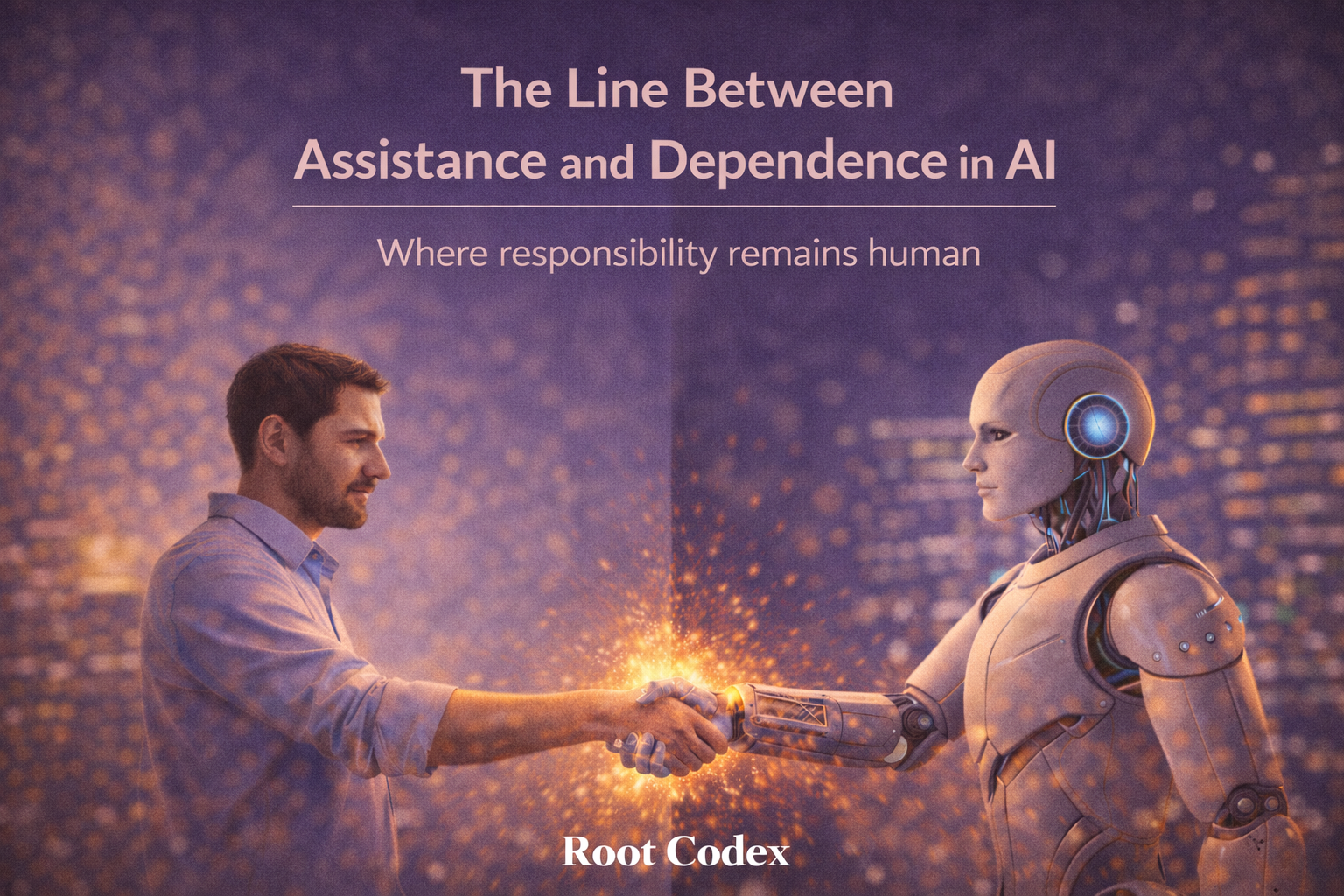
The Line Between Assistance and Dependence in AI

AI has quickly become part of everyday work. It helps us move faster, explore ideas, and reduce friction across tasks.
Where human responsibility begins
AI has quickly become part of everyday work.
It helps us move faster, explore ideas, and reduce friction across tasks.
But there is a quiet line that matters more than the tools themselves.
The line between using AI and relying on it.
1. Using AI supports thinking
When AI is used well, it acts as a companion.
It helps surface options, organize information, or speed up execution.
The human remains responsible for judgment.
Context, values, and intent still guide the final decision.
AI assists the process, it does not define it.
2. Relying on AI replaces responsibility
Reliance begins when thinking is deferred.
When outputs are accepted without questioning, reviewing, or understanding.
At that point, decisions lose ownership.
Not because AI failed, but because responsibility was quietly handed over.
3. Speed does not equal understanding
AI makes work faster, but speed alone does not create clarity.
Without reflection, fast answers can feel correct while missing the bigger picture.
Human responsibility lives in asking:
Does this make sense?
Is this aligned with our goals?
What are we not seeing?
4. Judgment is not a feature
AI can process patterns, but it cannot hold accountability.
It cannot weigh long-term impact, emotional nuance, or ethical consequence.
Judgment is a human responsibility.
So is deciding when not to act.
5. Strong teams define boundaries
Healthy teams are clear about where AI fits and where it stops.
They use it to enhance work, not replace ownership.
Boundaries create trust, clarity, and confidence in outcomes.
Final Thought
AI is a powerful tool.
But tools do not carry responsibility; people do.
The difference between using AI and relying on it shows up in the quality of decisions, not the speed of output.
Progress comes from pairing intelligent tools with intentional thinking.
That is where human responsibility begins.
👉 Curious how teams can adopt AI thoughtfully without losing clarity or control?
Reach us at [email protected] or call (+356) 27 368 513, and let’s explore responsible ways forward together.